

From 10 October to 6 December 2026, the Piedmontese city of Alba celebrates one of Italy’s most prized ingredients with truffle markets, chef-led cooking shows, tastings, fresh pasta workshops and events across the city.
For a few autumn weeks each year, the small city of Alba in northern Italy becomes the centre of a culinary obsession.
The reason is the Alba White Truffle — Tuber magnatum Pico, one of the world’s most prized gastronomic ingredients. But the International Alba White Truffle Fair is not simply a place where expensive truffles change hands.
Running from 10 October to 6 December 2026, the 96th edition brings together the Alba White Truffle World Market, cooking shows, sensory experiences, fresh pasta workshops, wine tastings, regional food markets and cultural events.
For visitors, that means there are plenty of ways to experience the truffle without arriving in Alba with the intention of buying one.
Start at the Alba White Truffle World Market
At the heart of the fair is the Alba White Truffle World Market, held at Cortile della Maddalena in the centre of Alba.
Open on Saturdays and Sundays throughout the fair, from 10 October to 6 December, the market brings together truffle hunters and traders offering fresh Piedmont truffles.
It is more than a display of extraordinarily expensive fungi. A Quality Commission oversees the truffles offered at the market, while visitors can also discover regional foods and wines from Langhe, Roero and Monferrato.
For someone visiting Alba for the first time, this is probably the place to begin. Even if you leave without a white truffle wrapped carefully in your bag, the market gives you an immediate introduction to the ingredient around which the entire festival — and much of Alba’s autumn identity — revolves.

What makes an Alba white truffle so special?
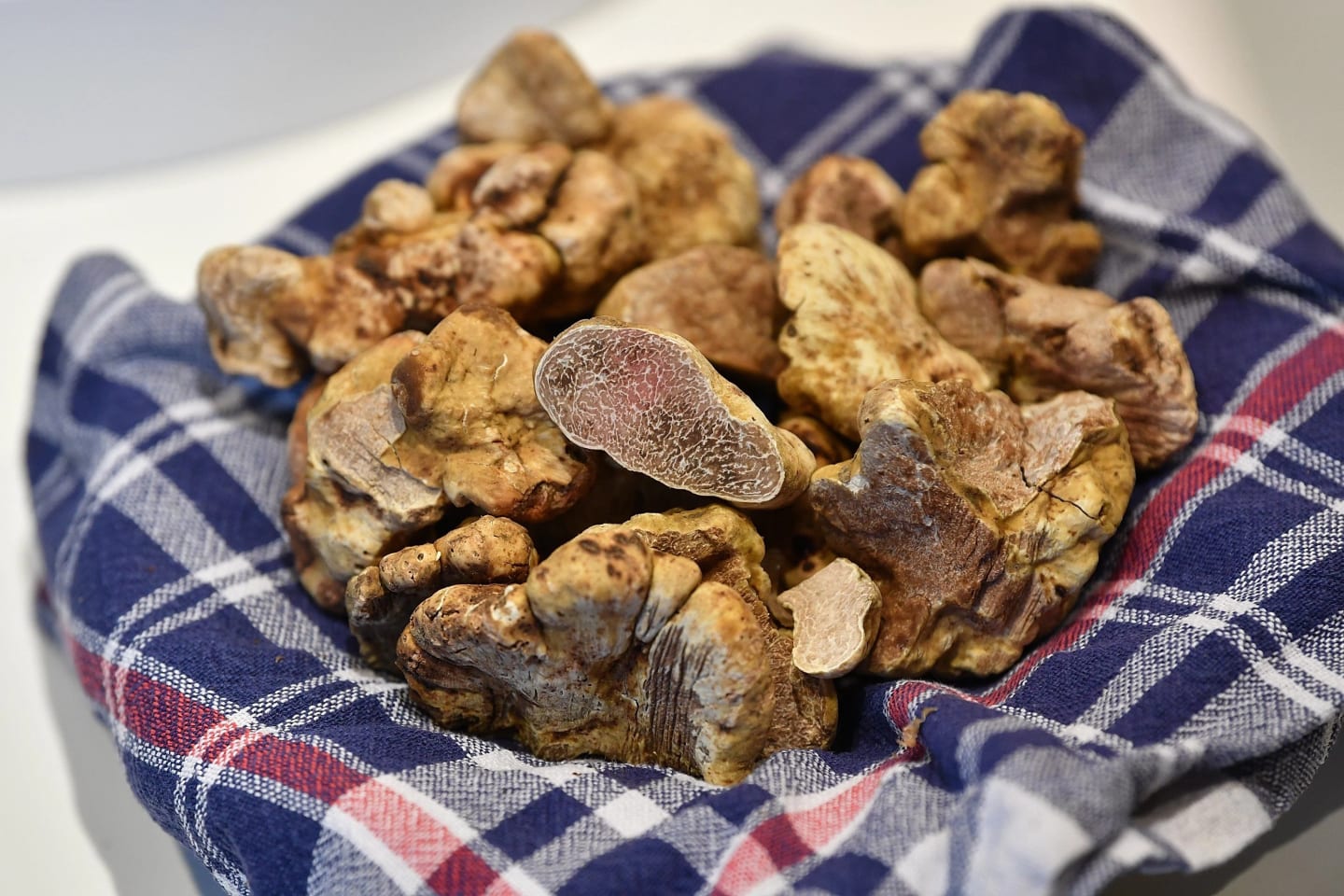
A white truffle does not announce itself with bright colour or an impressive shape. Its appearance is surprisingly modest.
Its appeal is in its aroma.
The Alba White Truffle develops underground and depends on a delicate relationship between soil, trees, water, climate and the surrounding ecosystem. Finding it traditionally involves a trifolau — a truffle hunter — working with a trained dog.
That fragility and dependence on nature are part of what makes the truffle rare, seasonal and so highly valued.
And unlike ingredients that are cooked into a dish, white truffle is usually at its most expressive when served raw, shaved in thin slices over warm food.
Eggs, risotto and Piedmontese fresh pasta become vehicles for its aroma rather than competitors for attention.

Learn how to recognise a good truffle
You can smell a truffle. But can you tell whether it is a good one?
The fair offers Truffle Sensory Analysis sessions led by judges from the National Truffle Study Centre.
Rather than simply presenting the ingredient as a luxury product, the sessions teach visitors how to evaluate it: how to identify quality, understand its aroma, store it correctly and get the best from it at the table.
Some of the 2026 experiences also include a guided visit to MUDET, the Alba Truffle Museum, creating a deeper introduction to the natural, historical and gastronomic story behind the ingredient.
A session listed for 16 October, for example, costs €35 and includes the sensory experience, admission to the World Market, museum entry and a guided MUDET visit. The experience is simultaneously translated into English.
For anyone genuinely curious about truffles rather than simply wanting to photograph one, this may be one of the most interesting tickets at the fair.
Watch the chefs — then taste the results
Of course, eventually somebody has to cook.
Throughout the fair, chefs take to the stage for cooking shows built around the white truffle and the produce of the region.
The format is deliberately more intimate than a conventional food demonstration. Visitors watch a chef prepare a signature dish while explaining ingredients and techniques — and the experience ends where every cooking demonstration should end: with food.
The 2026 calendar already includes Italian and international chefs across the festival weekends, with regular cooking shows and new fine aperitif experiences.
It is also an opportunity to see why white truffle is so often paired with relatively restrained dishes. When the ingredient itself is the star, the chef’s job is not necessarily to add more complexity.
Sometimes the most dramatic moment is simply shaving fresh truffle over a warm plate.


Or make the pasta yourself
Watching a chef is one thing. Making lunch yourself is another.
The Fresh Pasta Atelier turns visitors into participants, with hands-on sessions dedicated to Piedmont’s fresh egg-pasta tradition.
One of the stars is ravioli del plin — small Piedmontese ravioli whose name comes from the “pinch” used to seal the pasta.
Participants learn the basic techniques of fresh pasta making before tasting what they have prepared. White truffle can also be added on request.
The 2026 programme lists Fresh Pasta Atelier sessions from October into December, including dates on Wednesdays and Saturdays during the fair.
It is exactly the sort of experience that makes Alba more interesting as a food trip: you can arrive knowing almost nothing about Piedmontese cooking and leave having actually made one of its traditional dishes.

Save room for the rest of Piedmont
There is one danger in visiting Alba during truffle season: becoming so focused on the white truffle that you forget where you are.
This is Piedmont.
The surrounding Langhe and Roero are serious food-and-wine territory, and the fair uses the truffle as a gateway into the wider region.
On 31 October and 1 November, for example, Langhe and Roero in Piazza brings producers into Alba's historic centre with tasting stands devoted to regional specialities.
The list reads like a very convincing reason to arrive hungry: cheeses including Bra, Raschera and Castelmagno; mushrooms; cured meats; pralines and nougat; the celebrated Tonda Gentile delle Langhe hazelnut; and fresh pasta including tajarin and ravioli del plin.
Then there is the wine.
The hills surrounding Alba are home to some of Italy’s most famous wine landscapes, and wines from Langhe, Roero and Monferrato form an important part of the fair’s gastronomic programme.
In other words, coming to Alba solely for the truffle would be rather like visiting Champagne and forgetting about the wine.
The 2026 theme: “Authentic Relationships”
The official theme of the 2026 fair is Autentiche Relazioni — Authentic Relationships.
It sounds philosophical for a food festival, but in the case of the white truffle it makes sense.
The organisers describe the truffle not simply as a prestigious product, but as the result of relationships: between people and nature, communities and landscapes, tradition and innovation, and the people who protect truffle culture and those who travel to discover it.
The official 2026 visual captures that idea simply: a human hand holds a white truffle while the paw of a tabui, the traditional truffle dog, rests against it, with the forest behind them.
It is also a reminder that the most valuable thing at the fair cannot simply be manufactured in greater quantities when demand rises. The truffle exists because the ecosystem that produces it exists.
And then there is a truffle auction unlike most auctions
One of the fair’s most unusual dates comes on 8 November 2026, when the World Alba White Truffle Auction returns to Grinzane Cavour Castle for its 27th edition.
Exceptional white truffles are paired with wines from Langhe, Roero and Monferrato in an international charity event that has become a spectacle in its own right.
According to the organisers, the auction has raised more than €7.2 million for charitable causes since 1999, with participants over the years including philanthropists, chefs and figures from culture and entertainment.
You may not be going home with the winning truffle.
Watching the annual excitement around one of the world's most coveted ingredients, however, is another reminder that in Alba the white truffle occupies a space somewhere between food, culture and local treasure.
Planning a trip to the Alba White Truffle Fair 2026
Dates: 10 October – 6 December 2026
Where: Alba, Piedmont, Italy
Main venue: Cortile della Maddalena, Alba
White Truffle World Market: Saturdays and Sundays during the fair
What to expect: White truffles, regional food and wine, cooking shows, sensory experiences, fresh pasta workshops, markets and cultural events
Tickets: Some activities require separate tickets and advance booking
Language: Selected experiences offer English translation or English-language options
The fair runs for almost two months, so there is no single “correct” weekend to visit. Checking the programme before booking is worthwhile: chef appearances, workshops, markets and special events vary by date.
And Alba itself does not need to be the entire trip. The surrounding UNESCO-listed hills of Langhe, Roero and Monferrato make it easy to turn a weekend at the fair into a longer autumn journey through vineyards, villages and Piedmontese food culture.
Is it worth going if you are not a truffle expert?
Probably even more so.
You do not need to know how to judge a white truffle before arriving. That is partly the point.
You can walk through the market, learn to recognise its aroma, watch somebody cook with it, shave it over fresh pasta, taste the wines grown in the surrounding hills — and understand why an unassuming ingredient pulled from beneath the forest floor can bring people from around the world to a small Italian city every autumn.
The International Alba White Truffle Fair is ultimately not just about buying one of the world's most expensive ingredients.
It is about experiencing the place that gives it meaning.
Source: International Alba White Truffle Fair — Official Website
