

When we imagine an imperial banquet in ancient China, a simple radish is probably not the first ingredient that comes to mind. We might picture rare meats, elaborate pastries and precious spices arriving along the Silk Road.
Yet one of the dishes most closely associated with China’s only female emperor begins with an ordinary root vegetable.
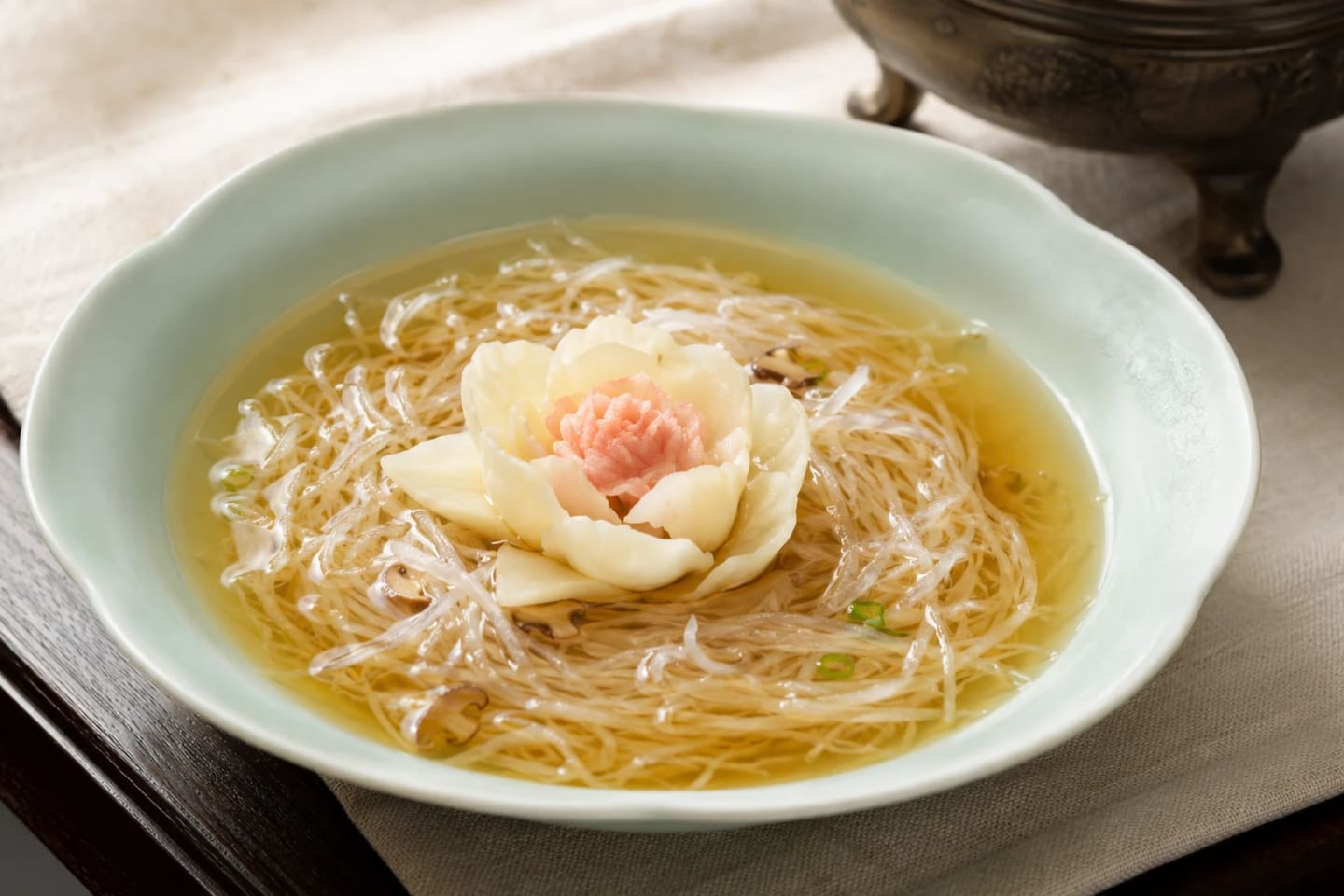
Its name is Mudan Yancai, usually translated as Peony Swallow Dish. Delicate white strands resembling an edible bird’s nest are served in a rich broth and crowned with a peony fashioned from egg, tofu skin or carefully arranged vegetables. Today, it is the celebrated opening dish of the traditional Luoyang Water Banquet.
But did Empress Wu Zetian really eat it?
The woman who became emperor
Wu Zetian entered the imperial court as a young concubine and eventually rose to a position no other woman in Chinese history officially achieved. In 690, she founded her own Zhou dynasty and assumed the title of huangdi — emperor, rather than merely ruling as an empress consort or regent.
Her reign was centred partly in Luoyang, one of the great capitals of imperial China. The city was wealthy, cosmopolitan and connected to trade routes that brought foreign merchants, ingredients and culinary customs into the Tang world.
This was a court capable of extraordinary luxury. But the dish linked to Wu Zetian is said to have arrived at the palace not as a costly delicacy, but as a remarkably large radish.
From a giant radish to an imperial delicacy
According to the best-known local legend, a farmer near Luoyang unearthed an enormous white radish and presented it to Wu Zetian as an auspicious gift.
The imperial cooks were then faced with a difficult task: how could a common vegetable be transformed into something worthy of an emperor?
They shredded the radish into extremely fine strands, coated or mixed it with starch and steamed it to soften both its texture and its sharp flavour. The translucent strands were placed in a savoury broth with finely cut ingredients such as meat, egg, mushrooms or seafood.
The finished radish looked surprisingly similar to the fibres of an edible bird’s nest—one of China’s most prestigious delicacies. This resemblance is generally used to explain the word “swallow” in the name. The dish does not contain swallows.
Wu Zetian, the story says, was so impressed that the creation became part of Luoyang’s culinary tradition.
Why is there a peony in the bowl?
The flower was a later addition to the dish’s identity.
Luoyang is famous throughout China for its peonies. In the modern version, a large ornamental peony sits at the centre of the bowl, surrounded by pale radish strands and golden broth. Its petals may be made from egg, tofu skin, vegetables or other edible ingredients.
The name Peony Swallow Dish is often connected with a 1973 banquet attended by Chinese Premier Zhou Enlai and Canadian Prime Minister Pierre Trudeau. After seeing the flower decoration, Zhou reportedly suggested that the celebrated Luoyang peony had “grown” inside the dish. The more elaborate name subsequently became popular.
This means that the dish seen in restaurants today is not an unchanged seventh-century recipe. It is a culinary tradition that has accumulated new ingredients, decorations and stories over many generations.
What did food taste like before chilli arrived in China?
Wu Zetian lived centuries before several ingredients now strongly associated with Chinese cooking reached the country.
There were no chilli peppers in seventh-century China. Chillies originated in the Americas and spread through global trade only after the voyages of the late fifteenth century. Tomatoes, potatoes, sweet potatoes and peanuts were also absent from Tang-period kitchens.
But ancient Chinese food was certainly not flavourless.
Cooks could use ginger, garlic, spring onions, mustard, cinnamon, aromatic herbs and the numbing berries now known as Sichuan pepper. Vinegar, salt, fermented beans and fermented sauces added acidity, depth and savoury flavour.
The Tang court was also remarkably international. Trade and migration brought grapes, pomegranates, sesame, certain spices and Central Asian cooking traditions into elite urban life. Wealthy diners could encounter unfamiliar breads, wines and dishes associated with merchants and communities from beyond China’s borders.
The result would not taste exactly like modern Chinese restaurant food—but it was far from plain.

A banquet that flows like water
Peony Swallow Dish is traditionally served as the first major hot course of the Luoyang Water Banquet, a formal sequence of 24 dishes: eight cold preparations followed by 16 warm ones.
Its name has several possible explanations. Many of the dishes arrive in soup, broth or sauce, while the courses themselves appear one after another in a continuous flow, like moving water.
The banquet combines humble vegetables with meat, seafood and carefully constructed garnishes. Sour, salty, sweet and peppery flavours appear throughout the meal. Presentation is important, but so is transformation: an inexpensive ingredient may be cut and cooked until it resembles something rare and luxurious.
The Swallow Dish embodies that idea perfectly. Radish becomes a bird’s nest; egg becomes a peony; soup becomes a piece of imperial theatre.
History, legend or clever culinary storytelling?
There is no surviving menu proving that Peony Swallow Dish was Wu Zetian’s favourite—or even that she personally ate the dish in the form known today.
The giant radish and delighted emperor belong to Luoyang’s culinary folklore. Sources describing the dish appropriately introduce the story with phrases such as “it is said” or “according to legend.”
Nevertheless, the legend tells us something valuable about the culture that preserved it. Imperial cuisine was not defined only by expensive ingredients. Skill, symbolism, texture, colour and the ability to surprise a guest could elevate something as ordinary as a radish.
More than a thousand years later, that remains the charm of Peony Swallow Dish. It offers the appearance of royal extravagance while hiding a very modest secret beneath its petals.
