
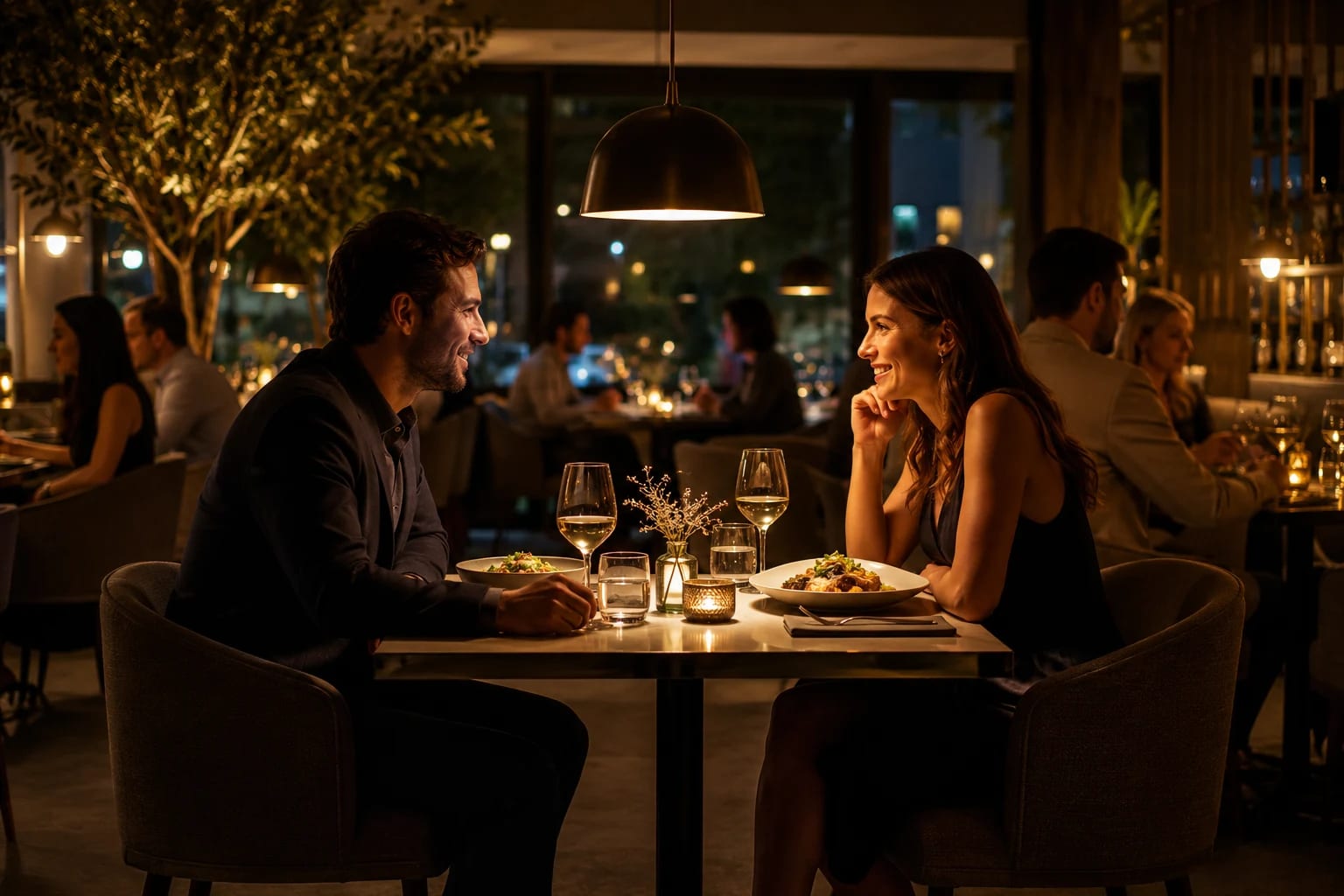
Choosing a restaurant for a first date sounds easy. Find somewhere with good reviews, make a reservation and hope the conversation goes well.
But the best restaurant in town is not necessarily the best restaurant for a date.
Food is only part of the experience. You are choosing a place where two people who may barely know each other are going to spend the next hour or two trying to talk, relax and work out whether they actually like each other.
That changes what you should be looking for.
1. Check the Noise Before You Check the Menu
One of the most practical things you can do before booking is surprisingly simple: search recent restaurant reviews for the word “noise.”
Background noise makes conversation more difficult and causes people to increase their vocal effort. There is even a name for part of this behaviour: the Lombard effect, our involuntary tendency to speak more loudly as the surrounding noise increases.
Before booking, search recent reviews for words such as “loud,” “noise,” “music,” “quiet” and “conversation.” Customer photos can offer clues too. Large open rooms with tightly packed tables and lots of hard surfaces deserve a second look.
You want some energy around you — just not so much that dinner turns into two hours of saying, “Sorry, what?”

2. Look for Table Lighting, Not Just “Romantic” Lighting
Dark does not automatically mean romantic.
Research published in the International Journal of Hospitality Management found that focal lighting around individual tables combined with a dimmer overall environment can increase perceptions of ambient intimacy.
In other words, look for a restaurant where the table is well lit even if the room around it is darker. You should still be able to see the person opposite you — and read the menu without reaching for your phone flashlight.
Check recent customer photos taken in the evening. They usually give you a better idea of the real atmosphere than professionally edited restaurant photography.

3. Choose the Time as Carefully as the Restaurant
The same restaurant can offer two completely different experiences depending on when you arrive.
A dining room at 6:30pm on a Thursday may be relaxed and easy to talk in. At 9pm on Saturday, the same place might have louder music, a busy bar and almost every table occupied.
For a first date, the busiest slot is not necessarily the best one. An earlier reservation can give you more breathing room, particularly somewhere that becomes livelier later in the evening.
The ideal is enough people to create atmosphere without making conversation difficult.
4. Don’t Automatically Book the Most Expensive Restaurant
A €150 tasting menu may be an excellent dining experience. It can also mean committing to several courses and several hours together before you have discovered whether the conversation lasts longer than the starter.
For a first date, flexibility has value.
Check how the restaurant works as well as what it costs. Is there an à la carte menu or only a tasting menu? Is most of the food designed for sharing? Is there a minimum spend or a strict reservation slot?
A useful rule is:
Impressive enough to show that you thought about it. Relaxed enough that nobody feels trapped.
Save the seven-course tasting menu for the date when you already know you want seven courses together.
5. Pay Attention to the Table
A tiny table squeezed between two other couples can leave you feeling as though you are participating in three dates simultaneously. A huge table can make a conversation between two people feel oddly formal.
When booking, asking for “a quieter table if possible” costs nothing.
A booth, corner table or simply somewhere away from the entrance and busiest circulation route can be worth more on a first date than the restaurant’s most Instagrammable seat.
6. Make Sure the Menu Gives Both of You Options
You love oysters.
Your date doesn’t.
You have booked an oyster bar.
Checking the menu beforehand prevents an unnecessary problem. A highly specialised restaurant is a great choice when you already know that both people love what it serves. It is a bigger gamble when you know little about the other person’s preferences.
Look for enough variety that both of you can comfortably find something to order. The same applies to vegetarian and vegan choices, allergies and other dietary requirements.
You do not need to conduct a dietary questionnaire before meeting someone. Just make sure the other person has an actual choice rather than one reluctant option.
7. Think About What Happens After the Bill
Do not just look at the restaurant. Look at what is around it.
If the date is going well, having bars, late-opening cafés, a waterfront, promenade or simply an interesting area for a walk nearby creates an effortless second step.
Instead of “So… what do we do now?”, you can simply ask: “Want to go somewhere for a drink?”
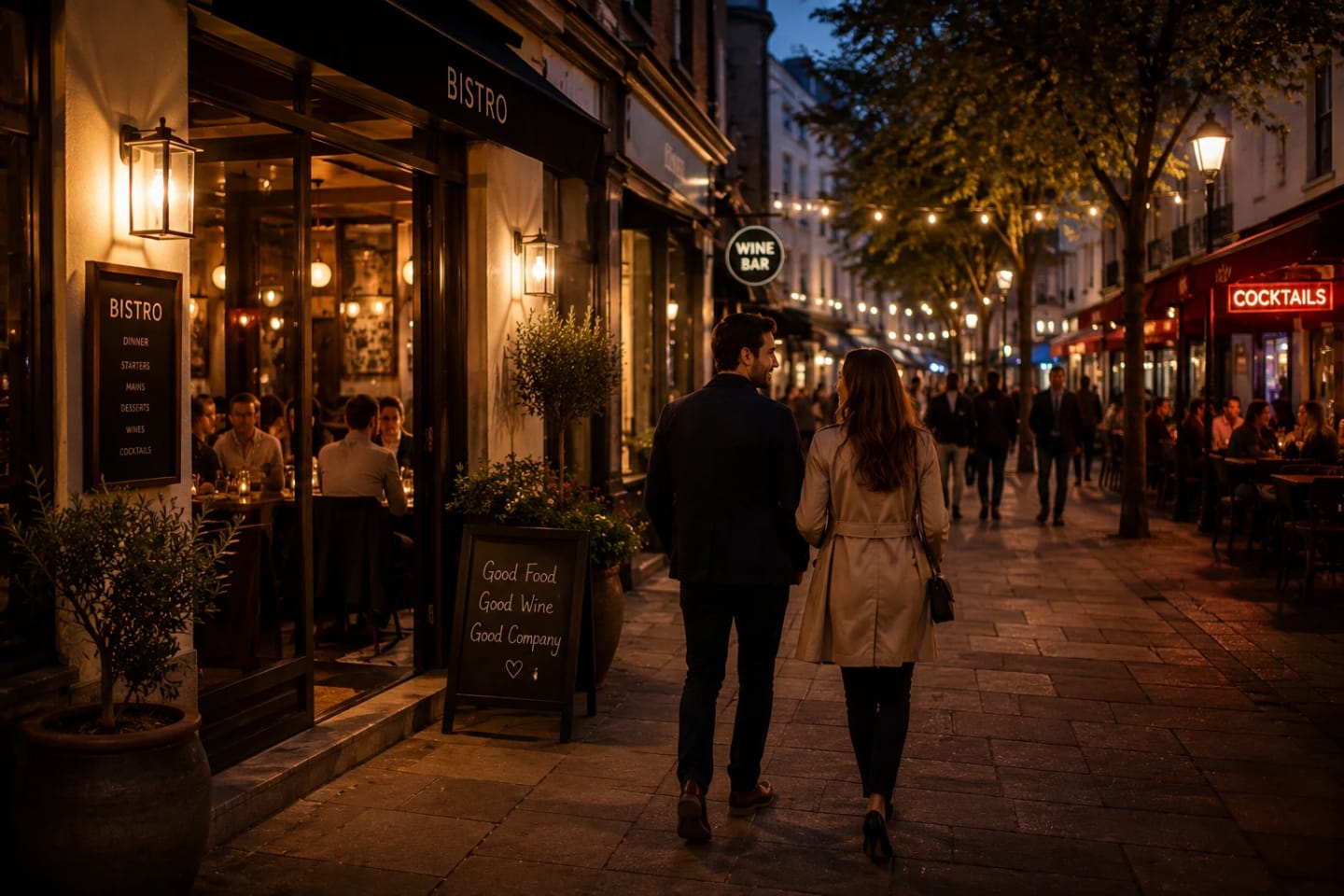
And if there is no connection, dinner still has a natural ending. You have not committed the other person to dinner, cocktails and an activity before you have even met.
The 30-Second Test Before You Book
Before confirming the reservation, check six things:
Noise → Lighting → Menu → Price → Seating → What’s nearby.
Can you talk comfortably? Can you see each other properly? Can both of you find something to order? Does the price feel appropriate? Is the seating comfortable? And if the evening is going well, is there somewhere nearby to continue it?
If the answer is yes, you have probably found a good first-date restaurant.
And notice what is missing from that test.
A Michelin star.
The restaurant does not need to be extraordinary. It needs good food, enough atmosphere and as few distractions as possible.
The restaurant should set the scene. The person sitting opposite you should be the interesting part.
